issue 01.B
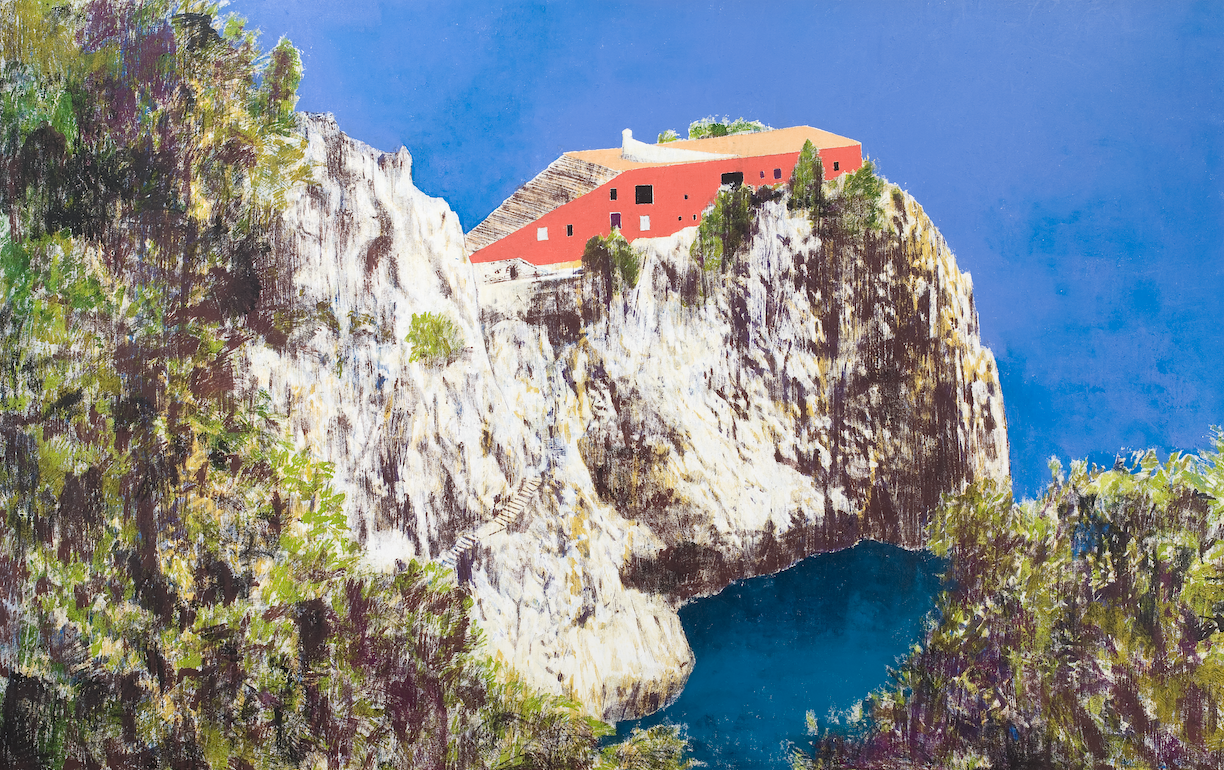
Enoc Perez, Casa Malaparte (Day), 2008, Oil on canvas, Courtesy Of Collezione Maramotti, Photo by Carlo Vannini
EDITORIAL NOTE
[the] GFA Journal, Editor Dina Giordano
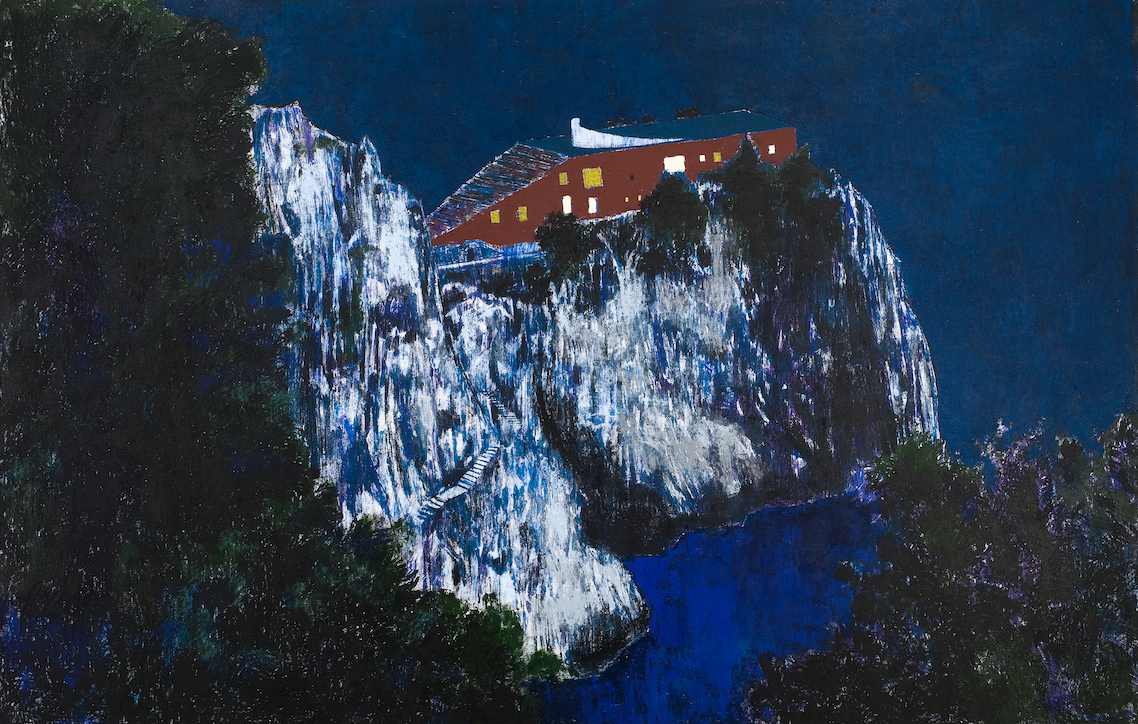
Enoc Perez, Casa Malaparte (Night), 2008, Oil on canvas
Courtesy Of Collezione Maramotti, Ph. Carlo Vannini
Editorial Note, Issue 01. B opens [the] GFA JOURNAL by looking at cues from poetry, tracing how artists have long been seeking to reduce expression to its most essential elements and emotions.
We look to decades of artist from all disciplines to see how this concept of poetry resonates and influences their work. From Hugo Ball and Emmy Hennings’s Cabaret Voltaire, to concrete poetry, Le Corbusier and Edgard Varèse’s Poème électronique, and John Hejduk’s poems in architecture. Or how a poet’s voice, such as Pier Paolo Pasolini, shows up in his film work. The issue begins in conversation with Laura Bardier, founder, curator, and director of ESTE ARTE, an art fair for deep connection, whose reductive practice speaks to the canon, visibility, and a regional gaze. A curated selection of Daily Discoveries follows poetry through space, object, voice, machine, sound, and image, and wonder, from Nancy Holt and the Noigandres poets to María Zambrano. With a conversation of text with art & architecture, we welcome from the Archive, Mario Diacono’s text on Enoc Perez’s Casa Malaparte, contributed by Fosca Ugoletti of Collezione Maramotti, which considers painting made like a print and a writer’s house built like a poem. The issue closes with Taj Marquis Reed’s “Exegesis-Autofiction & Prose,” where text answers image and returns both to the personal archive.
Interview with laura Bardier
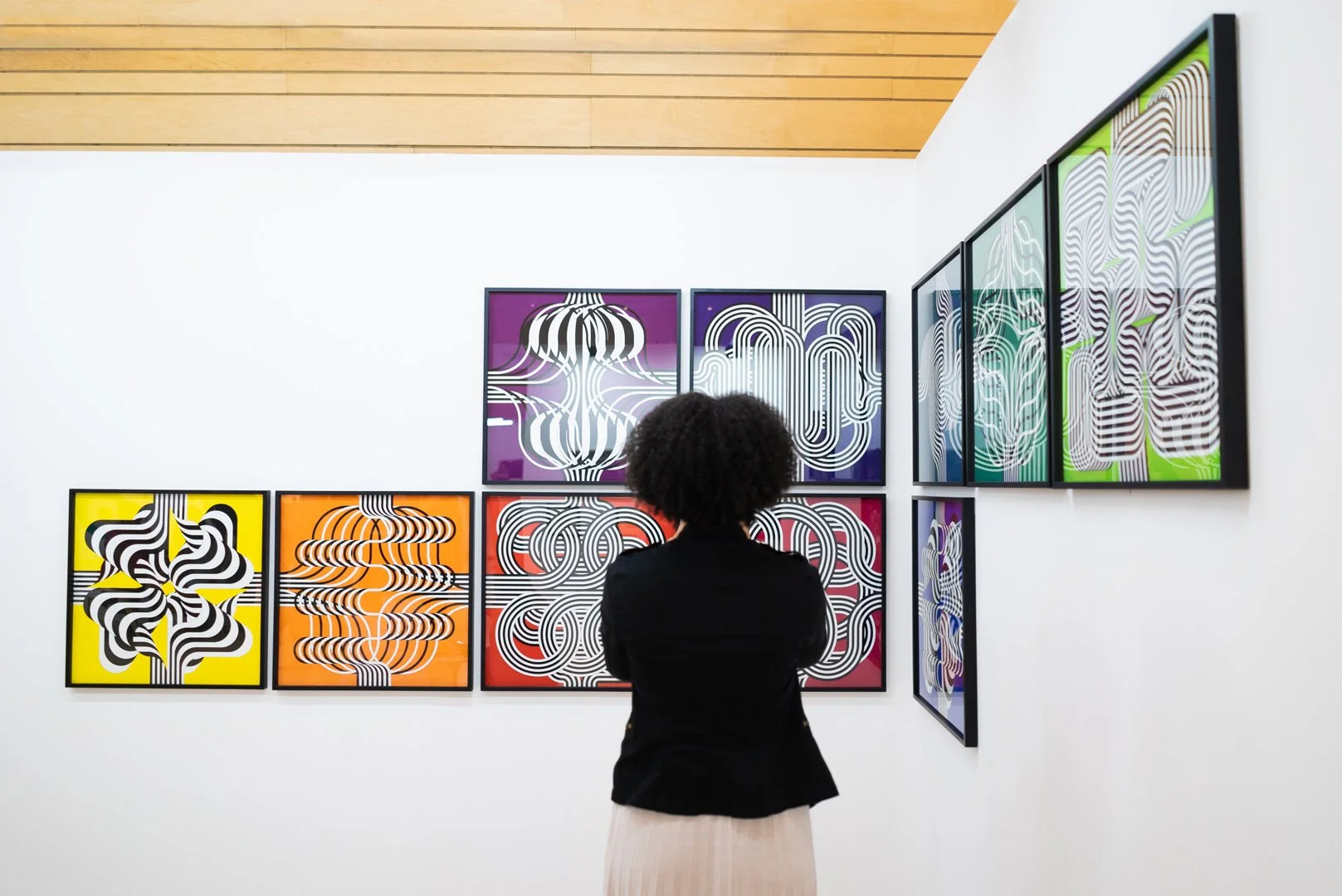
Photograph Provided by Este Arts
Laura Bardier is the founder and director of Este Arte, a Uruguay-rooted foundation and art fair dedicated to Latin American art. Under her direction, the fair has taken a deliberately lean form: fifteen booths, each devoted to a single artist’s exhibition, with major collectors serving on its submission review committee.
In conversation with Laura Bardier is the interview for Issue 01.B. Dina speaks with Bardier about Este Arte’s founding and its grounding in Uruguay and the wider region, and about where its work meets the JOURNAL’s prompt “The Dialectical Third: Warhol, Influence, and the Global South.” The conversation turns to queer portraiture and a regional gaze, with Bardier pointing to artists across generations, including Ulises Beisso, Feliciano Centurión, Marcelo Benítez, and Dani Umpi, whose work complicates ideas of gender, intimacy, and representation; for her, queer art in the region is not one aesthetic but many strategies for making the self visible. She addresses identity labels and the canon, arguing that naming exclusion remains necessary but should not become a permanent container for an artist. The interview closes on the fair model itself: the value of constraint, the 2026 “happiness discount,” and a broader shift toward generosity and collaboration in arts leadership, and what meaningful North and South institutional collaboration can look like.
“The goal is not to erase difference; it is to reach a point where difference does not have to function as a prerequisite for recognition.”
– (On identity labels and the canon.) In Conversation with Laura Bardier, Curator/Director/Founder, Interview 01. B Issue
Daily discoveries
Nancy Holt (1938–2014), Concrete Poem, 1968 (printed by the artist in 2012), Inkjet print on archival rag paper from an original 126-format transparency. © Holt/Smithson Foundation / Licensed by Artists Rights Society, New York
Daily Discovers: GFA’s Field Notes →
Daily Discoveries [the] GFA JOURNAL's Issue 01. B is a curated sequence of six entries, the foundation’s own field notes on how poetry takes form beyond the printed line. Read in order, they move from the land to the page, into the voice, the machine, and the moving image, and end at the root of it all: wonder.
Nancy Holt: Concrete Poems · space
Holt’s early concrete poems, written from a specific location and an awareness of the space around her, led to the site-based work of her Buried Poems and Sun Tunnels.Noigandres: The Pilot Plan · object
Augusto and Haroldo de Campos and Décio Pignatari, the São Paulo poets who solidified concrete poetry alongside European writers. Their 1958 manifesto for the word as visual object takes its title from Lúcio Costa’s Plano Piloto for Brasília.Poesia Sonora: Italian Sound Poetry · voice
Italian poets who carried language off the page and into the voice, from Mimmo Rotella and Arrigo Lora-Totino to Patrizia Vicinelli, Giulia Niccolai, Tomaso Binga, and Giovanni Fontana.Sisters with Transistors · machine
The documentary on the women who pioneered electronic music, including Daphne Oram, Delia Derbyshire, Pauline Oliveros, and Laurie Spiegel, who composed with machines.FreshMula: Directing the Image · sound + image
The Italian-Senegalese rapper and director who writes the music and directs the video, carrying poetry’s oral tradition into the moving image.María Zambrano · wonder
The Spanish philosopher who, in Filosofía y poesía (1939), traced philosophy and poetry to a single root: wonder at existence, the amazement of daily discovery.
Remembering Mario Diacono
Casa Malaparte (Night), Oil on canvas, Courtesy Of Collezione Maramotti, Photo by Carlo Vannini
“Constructing Painting” by Mario Diacono was written for Casa Malaparte, Enoc Perez’s 2008 exhibition and the first temporary show at Collezione Maramotti, and is selected for the JOURNAL by Fosca Ugoletti, Head of the Library and Archive. Diacono opens with painting’s long struggle to justify itself against new image technologies, arguing that it remains rooted in its magical origins. He then takes the reader into Perez’s studio, where there are paintings but no brushes: Perez traces photographs onto paper, one sheet per color, and presses the paint onto canvas in layers, a hand-made process that imitates the copy machine. For Diacono, this lets Perez revisit Warhol’s mechanical distance while restoring the hand, and his repeated architectural icons recall Monet, Warhol, and Jasper Johns in showing how an image changes across a day or a life. The essay closes on the two canvases themselves, drawn from a frame of Godard’s Le Mépris: Malaparte’s red house on Capri by day, read through De Chirico’s Red Tower, and by night, through Böcklin’s Isle of the Dead, where the visible summons the invisible..
Text selected by Fosca Ugoletti, Collezione Maramotti, from Enoc Perez. Casa Malaparte (Gli Ori, 2008)
Taj Marquis Reed, "Auto Fiction & Prose"
Contributing essay
Gist and Billy in Mary’s sitting room, circa 1980 (photographer unknown), Archival Polaroid 3.108 x 3.024 inches (7.89 x 7.68 cm)
Taj Marquis Reed (b. Trenton, NJ) is a multidisciplinary artist working across image-making, text, and assemblage, with a focus on the liberatory potential of visual and textual literacy. He holds a B.A. in art, literature, and human behavioral studies, summa cum laude, from St. Mary’s College of Maryland and is an MFA candidate in Image-Text at Cornell University. He lives and works between Harlem, New York, and Southern Maryland.
“Exegesis” (excerpt) is an autofiction and prose work written for Prompt 03, “The Polaroid: Art, Analog Practice, and Archive.” It draws on the archive of family photographs Reed inherited from his great-grandmother, Grandma Gist, after reconciling with his paternal family. Written as one of a series of letters to living, remembered, and imagined relatives, the piece returns to her house on Jackson Street in Trenton’s Mill Hill, where Polaroids, drugstore prints, and pages torn from Jet hung salon-style beside portraits of Black American icons. Reed calls it a museum of matriarchal art, a family devotion to the printed image rather than the camera. The excerpt belongs to Exegesis, an ongoing serial project spanning writing, photography, sculpture, and installation. It runs with two images: Sanctuary (or Mary’s sitting room), 2023, and a family Polaroid, Gist and Billy in Mary’s sitting room, circa 1980.