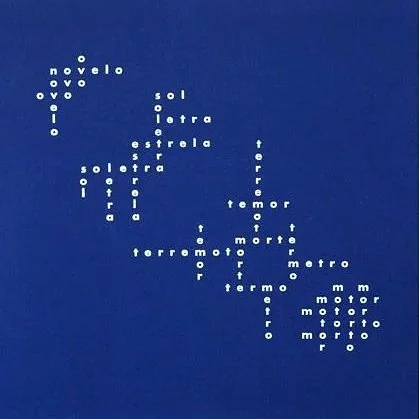
Augusto de Campos, “terremoto” (1956)
[the] GFA Journal issue 01. section B(01.B)
A Line of Sound and Color: An issue on poetics
Issue 01. B looks at the poet in every medium, from Laura Bardier’s ESTE ARTE and Mario Diacono’s writing on Enoc Perez to concrete poetry, sound poetry, and the women of Sisters with Transistors. Daily Discoveries trace poetry through space, object, voice, machine, sound, and image, and wonder, ending with María Zambrano. Taj Marquis Reed’s “Exegesis” closes the issue, where text answers image in a family archive of Polaroids.
Issue Editorial Note 01. B
a line of Sound and Color:
an issue on poetics
By Dina Giordano
Dear Reader,
The poet is at the heart of every artist, composer, architect, and writer. The poet is not afraid of innocence. The poet will dismantle logic and arrive at the unknown. The poet chases the curiosity of chance down la scala, seeking a delight in humanity to spark within them, and knowing that spark is the thread to all humanity.
In this issue, we will look at the poet through different mediums, eras, and styles: the absolute freedom afforded to those who dare to be taken on the wondrous ride of discovery.
The earliest forms of poetry are said to have been sung or spoken before written language. The oral art of poetry had rhythm and lyricism built into its origin. Poetics span from religious hymns and chants to rap.
The issue begins in conversation with Laura Bardier, founder, curator, and director of ESTE ARTE in Punta del Este. ESTE ARTE is an art fair for deep connection, with a focused approach of 15 booths and single-artist exhibitions. It shares a space with the poetic: distilling the essential and extracting the non-essential, common to concrete poetry's element of careful elimination.
Bardier speaks to the canon: who has been left out, the need for visibility, and a regional gaze that isn't defined by how the US or Europe frames it. Naming exclusion still matters, she argues, but no artist should move from being invisible to being permanently contained by a label. Her answer on queer art in the region stays with me: "It is a field of very different strategies for making the self visible."
We have the honor of celebrating Mario Diacono, a poet, art critic, and dealer. He wrote about painting with a poet's ear. A year after his death, we share his text "Constructing Painting" From the Archive, selected and contributed by the Archive at Collezione Maramotti, with thanks to Sara Piccinini and Fosca Ugoletti.
Diacono wrote it for Casa Malaparte, in response to two large canvases by Enoc Perez of Curzio Malaparte's house on Capri, by day and by night. Malaparte was a writer, a poet who made architecture, shaping his home to be a "house like myself."
Perez works by tracing photographs and pressing paint onto canvas one color at a time, mimicking a Risograph printer, but by hand. Diacono reads it as time made visible: "One would thus experience the expression of time in a continuity of space."
From there, the issue leads into a curated selection of Daily Discoveries, the foundation's own exercise in the sensory arts and in how many forms a poem can take. We recommend reading them in order: space, object, voice, machine, sound and image, wonder.
Nancy Holt embraced "wonder," the same wonder María Zambrano names at the close of this sequence: the connection to the cosmos, to what was beyond us but connected in all of us. She adopted the practice of concrete poetry, which had emerged about a decade before, though she did something unique, integrating photography and spatial context within her work. Holt was interested in systems, particularly systems of language. She would use the Interstate highway network and her camera to create visual poems from repeated observations.
The Noigandres poets wrote concrete poetry in Brazil in the 1950s, deconstructing words as visual, sonic, and structural material. Graphic design became part of the art and impact of the work, with page layout, spacing, and color playing active parts in its meaning. They drew on Ezra Pound's ideogrammic method, James Joyce's "verbivocovisual" wordplay, Stéphane Mallarmé's spatial constellations, Constructivism, and Brazilian modernism. This deductive resonance is a witnessing of humanity.
Italian sound poetry breaks free of the constraints of grammar and linear structure and experiments with freedom, liberating words both on paper, through visual and concrete typography, and through spoken word, vocal recitation, and phonetic invention. It embraced technology and synthesizers to make sound art, not unlike the women in Sisters with Transistors.
Sisters with Transistors follows the first women who broke through the silence and whose voices are now embedded in electronic music. Technology gave them the freedom to connect directly with their audience. "Technology blows up power structures," Laurie Spiegel says in voiceover.
The critic Hilton Als, a master of switching registers, has said that when he writes outside of review, he follows the laws of poetry, "which means there is sound and meaning."
FreshMula writes by those same laws: in lyrics, sound, and video, he brings sampling that captures the momentum of the past and points toward the future. He carries poetry's oral tradition, from gospel hymns to rap, into the present.
And María Zambrano, whose career as a philosopher and writer spanned 60 years, made the case that philosophy and poetry originate from a single impulse: wonder at existence. Her life's work, poetic reason, aimed to fuse philosophical prowess with poetic intuition. In her works Filosofía y poesía (1939) and Claros del bosque (1977), the emotional body and life merged with intellectual depth.
Issue 01. B closes with Taj Marquis Reed's "Exegesis," an autofiction and prose piece written in response to the prompt The Polaroid: Art, Analog Practice, and Archive. Reed brings us on a journey through his family's archives and the memories they evoke, through the images of his great-grandmother's house, its walls hung salon-style with family Polaroids beside Malcolm, Martin, and a melanated Jesus, a place he calls "The Museum of Matriarchal Art." Here, text speaks to the image, and both draw you closer to a shared familial experience.
Susan Sontag wrote in her journal in 1964, "Only a fraction of me is available to be turned into art." The scant attempts to capture humanity and emotion are beautiful, real. The fasting of materials, the printing of language, and the elimination of form plot a new perspective. The chosen words reveal a firmness of introspective curiosity, and at other times an outward acknowledgment of joint suffering. We look at poetry in all its meditative forms, from object, to sound, to video, to language. A vulnerability of form, of emotion: people who can distill the complex to its essence. Pruning humanity is what artists have done in every form. This practice of distilled extraction has found itself in architecture, curation, music, video, and poetry, and it points us toward oneness.
With gratitude,
Dina Giordano