Constructing Painting
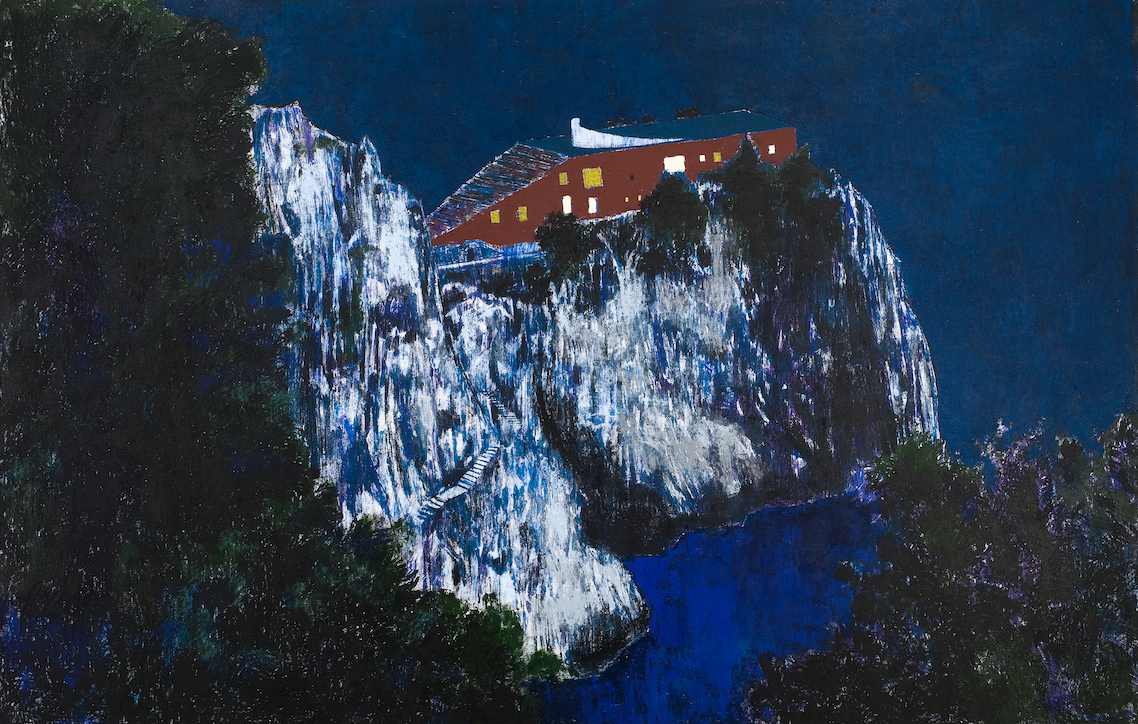
Enoc Perez, Casa Malaparte (Night), 2008, Oil on canvas, Courtesy Of Collezione Maramotti. Photo by Carlo Vannini
“Constructing Painting”, text for the exhibition’s catalogue, Enoc Perez.
Casa Malaparte, Collezione Maramotti, Reggio Emilia, 7 June – 26 October 2008
Text by: Mario Diacono
Publisher: Gli Ori. Editori Contemporanei, Pistoia
Year of publication: 2008
Enoc Perez’ paintings insistently summon in their imagery either a specific architectural structure — whose choice is determined by an emotional involvement, or by its perceived ideological and intellectual pregnancy —, or low-brow Dionysian still-lifes, almost always focused on the Caribbean accouterments of cocktail parties. These images connote the central place that for the artist’s project have, however committed he may be to the mise-en-scène of Expression, the figures of sociality. At the same time, however, that he insists on the symbolical value of these icons, he points also to their abstract dimension, as if the surface of a painting were a screen on which the figures, exposing their purely mental reality, crystallize into corporeal enigmas. “Painting” has intermittently found, over the last one hundred years, that it has again and again to prove its existential legitimacy, face to an accelerated evolution in the technologies of communications, which shape our perceptual environment, and to an increasing spectacularity in the modalities of the visual arts. These changes constantly seem to challenge its expressive viability, and to invoke its presumed obsolescence. More and more images around us result from, or strive to embody, new technical procedures marked by heightened visual speed and varied modes of perception. This is, indeed, the story of the last millennium of Western art. Yet painting remains still today somehow rooted in the magical intentions on which founded its origins, as it will almost certainly in the future — a foundation that colors its existence, and that demands an incessant ability to blend newness of presentation/representation with its role as an quasi-religious agent of transcendence. But since magic too implied and employed a technique, albeit sacred, for bending the real to the imaginary, and the imaginary to the real, the meaning of signs has always been inseparable from the concepts ordering the image. The figures that Enoc Perez lifts from photographically recorded symptoms of sociality, and then transfers as chromatic textures onto canvas through processes that de-compose and recompose their outlines, are transmuted by an inner necessity into anxious evocations, for they derive their topical intensity from an interrogation of experience. So they tend to reappear, in works made months or even years apart, as images that look the same but have nonetheless a different iconicity, not just for their incessant shifting in color scheme, but because the act of fragmentation and recomposition follows by necessity biological rhythms, which, even reiterated, can never be the same. Still, these pictures can’t to be thought of as “serial” repetitions, re-enactements of the Marilyns, Jacquelines, Lizs, or Maos that had converted into a new mythology some enduring religious archetypes, even though they conceptually reframe the forms and conventions of portraiture. On entering Enoc Perez’s studio, the first thing one notices is: there are oil paintings on the walls, but there are no brushes on the tables or the floor. The artist himself is quick to let you know that he works with a kind of printing (or transfer) procedure, building up the canvas’ textured surface by superimposing layer after layer of paint, one color at a time, without recourse to brushes or spatulas. Up until not very many painters ago, and the appearance of Photoshop, most images we find in a picture emerged almost always from drawings. Perez’s figures, like those of countless other representational artists today, derive from photographs which either he takes himself, or he appropriates from magazines and postcards: found or rediscovered memories. And they never re-enact the chance encounter of a sewing machine and an umbrella on the operating table. The photograph is then projected onto a sheet of paper the same size as the canvas, and the outline of its figure is traced on the paper with a pencil. The operation is repeated for as many times as the number of colors the artist has decided to use in a given painting. The back of the first sheet is then covered with a layer of oil paint coming directly from a plastic cylinder of oil paste. Successive colors, or layers of paint, are applied to separate sheets and then transferred/printed onto the canvas, along the lines of the image drawn on the opposite side of the sheet of paper. The mixing of pigments, for which palettes are traditionally used, results here therefore from the sequence of positions, superimpositions, and juxtapositions that purposely paraphrases the procedures of mechanical reproduction employed by copy machines, which in their printing process effect the scanning of four colors: black, yellow, magenta, and cyan. Which have come to replace, in a sense, the classical primaries of red, yellow, and blue, so emblematic in, and of, the work of Mondrian (who, however, also needed black for the lines of his grids, either real or virtual) and, in some signature paintings, Barnett Newman. The extent to which this mechanical lingua franca has become a part of the making of art is also shown by the recent work of Kelley Walker, who employs a similar procedure not mimicking it, as Perez does, but following it literally. Walker describes the process in an interview with Bob Nickas: “I start with scanning individual bricks and cinderblocks and importing them into Photoshop, where I lay them out much like a bricklayer stacks bricks when building a wall. Then that file is color separated into four silkscreens consisting of the four process colors: cyan, magenta, yellow, and black. Then the four screens are printed back on top of each other using process ink — transparencies — to build a photographic image of bricks and cinderblocks.” Perez does not limit himself to the four post-primary colors of the photomechanical reproduction, making instead use of a wide range of hues, layered and superimposed according to the expressive needs of each individual piece. But his method does appropriate the essential element of the printing process: paint is pressed onto the canvas, not brushed. And in adopting these strategies for constructing his pictures- a lifting of readymade images from photographs, an application of color that mimics the copy machine- he sets himself up to reframe the historic and stoic Warholian/conceptual distancing from subjectivism, at the same time extricating himself from the strict limits of mechanical (re)production through the deliberate intervention of the hand (at the very beginning of art, this intervention of the hand is fundamental to the crafting of magical signs: it summons events by the sheer ability to symbolically represent them). Since Perez’s images are drawn on one side of the matrix, and then transferred to the canvas by printing the paint laid on the other side, the image is activated in his work through a process that might be called counterfrottage, for a frottage is obtained by rubbing charcoal or graphite across a sheet of paper pressed against an extant figure. But the resultant printout will necessarily have a measure of incompleteness that can allude to an evocation: el sueño de la tecnología produces monstra, pictures that conceptually replicate a mechanical procedure while their images are still generated by an internal interrogation.
“El sueño de la tecnología produce monstruos”
- Mario Diacono
Diacono rewrites Goya’s The Sleep of Reason Produces Monsters (Los Caprichos, 1799), replacing reason with technology. With sueño meaning both sleep and dream, and the Latin monstra meaning omens as well as monsters, the line casts Pérez’s hand-printed paintings as signs born from the dream of the machine
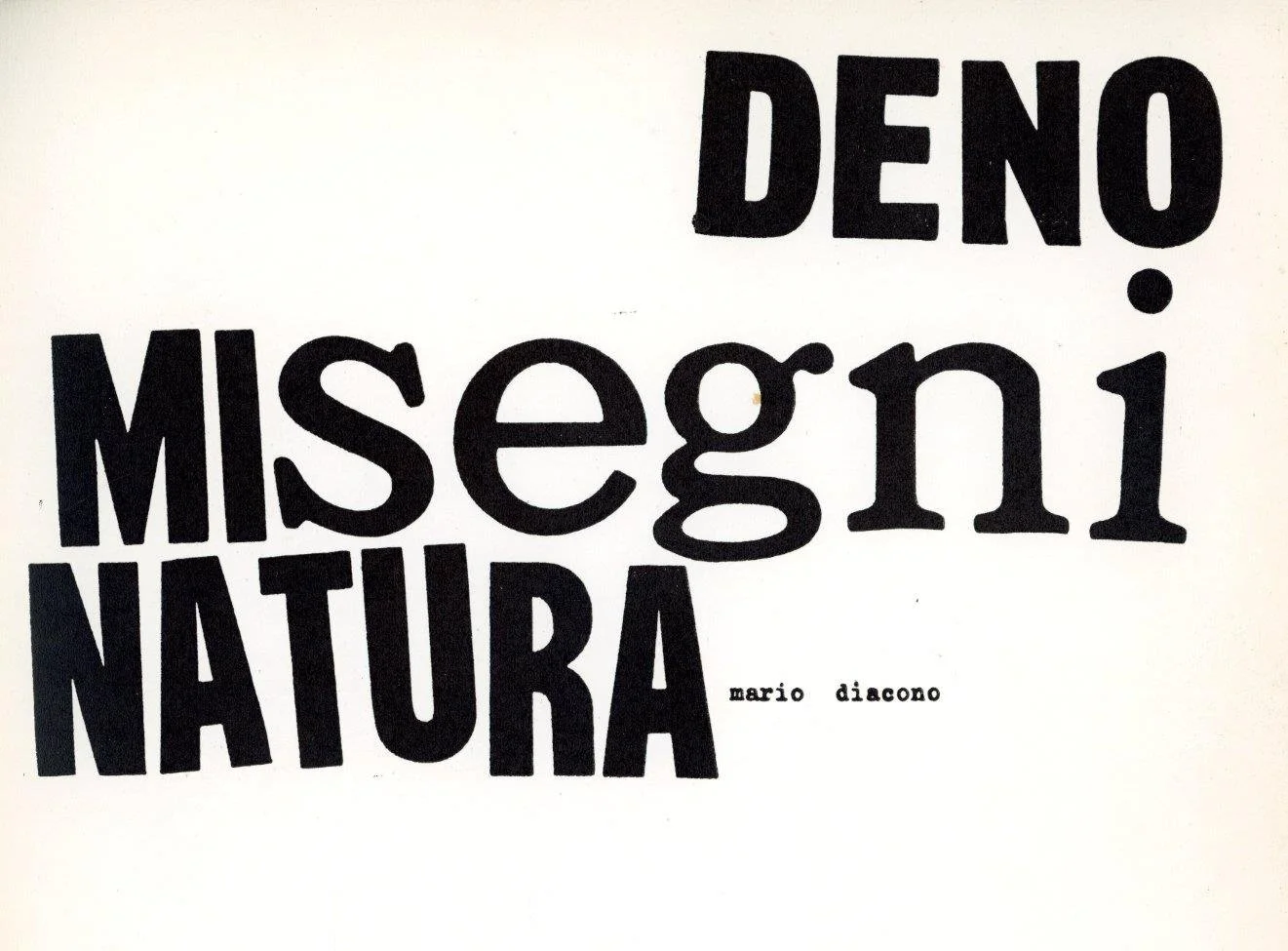
The cover of Denomisegninatura, a rare 1962 book by Mario Diacono, published in Rome by Edizioni EX
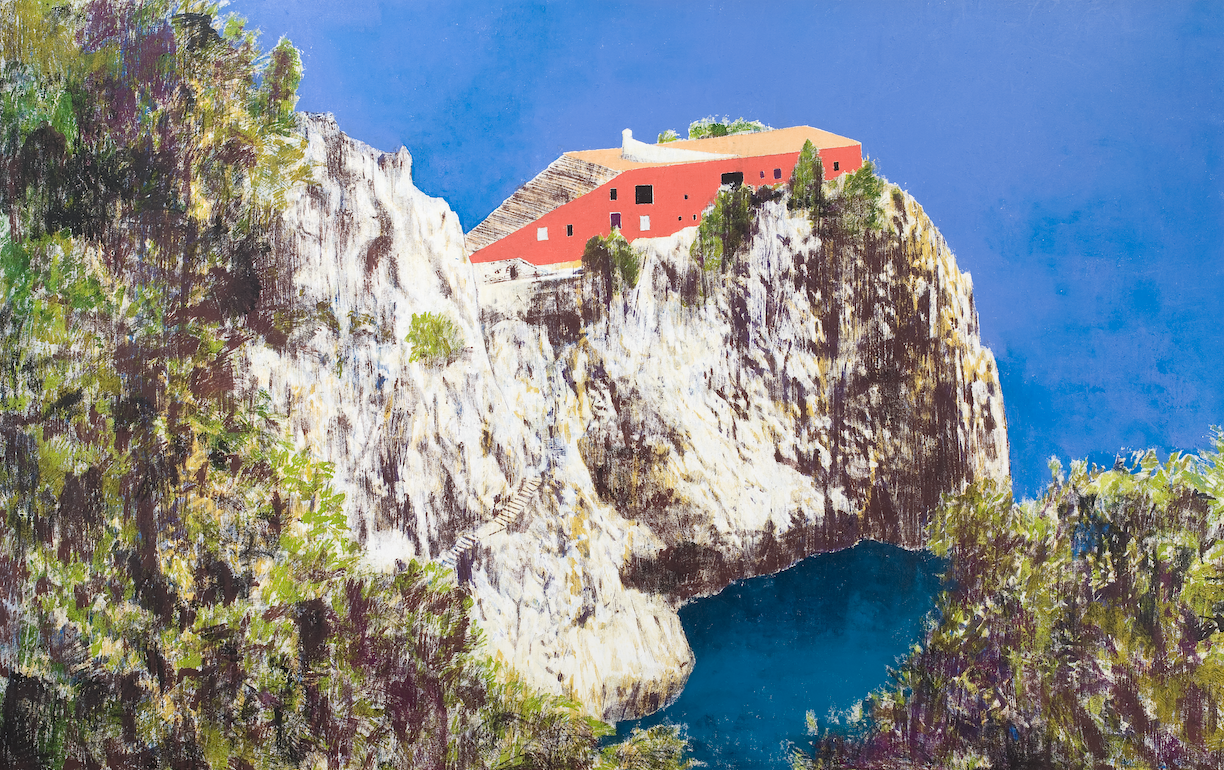
Enoc Perez, Casa Malaparte (Day), 2008, Oil on canvas, Courtesy Of Collezione Maramotti. Photo by Carlo Vannini
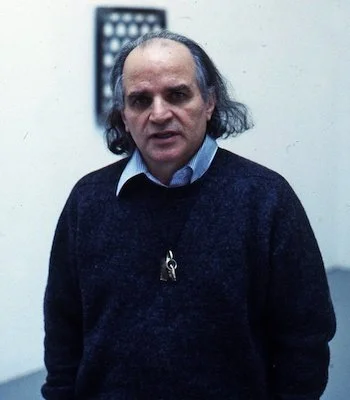
Mario Diacono, Boston, 1985. Photo: Charles Giuliano
Since painting was born in the cave, in sacred/ritual spaces that were found and recognized as such only in the last century, in the epoch of the avant-gardes (alongside the “discovery” of African and Oceanic sculpture, that mostly evoke instead open, if also sacred, spaces), it’s not surprising to see artists today fully engaged in forms of environmental expression, one that might once again appear to shift painting back from the realm of subjective consumption to a primal status of community rite. Analogous trends emerged at times in which religion and the visual arts experienced periods of expansion and renewed vitality: the churches of the Middle Ages; the chapels of the Renaissance; the Buddhist caves and monasteries of India, China, Ladakh, and Tibet; the murals of the Mexican painters between the two World Wars. Enoc Perez’s reiteration of a single architectural icon in works of various dimensions and color intentions seems indeed to derive from a similar impulse, even if it has obvious precedents in the works of Monet and Warhol, for instance. Namely, it postulates — even demands — the existence of virtual places in which the viewer may cast a long, single gaze at the changes that an idea undergoes in the course of a day, of an epoch, or a life (Jasper Johns constantly painted pictures in which an image was rendered first in the primary and complementary colors, then almost identically in only shades of gray: the best known, False Start, cm 171 x 137, and Jubilee, cm 152 x 112, both from 1959). One would thus experience the expression of time in a continuity of space. The registers of day and night, of solar and lunar light, in which Perez renders Casa Malaparte in the two paintings on exhibition here constitute the most recent, the culminating one, of the many versions this image has known over a number of years. In the previous paintings and drawings — all based on the same view of the house, taken from a frame of Godard’s film Le mépris, 1963 — appears cut away the left-hand side of the movie image, and the cut emphasizes the building’s visionary shape. As suggested by Emilio Ambasz, this secular mini-cathedral dressed in Pompeian red is, in fact, remarkable for the way in which the “façade” has been replaced by a long and solemn staircase that rises toward a vast, simple roof whose absolute flatness is relieved only by the solitary punctuation of a curve, saillike, almost Piranesian white wall. And those stairs, leading only to the sky, seem to take on the meaning of a porta coeli (possibly inspired by Monte Sant’Angelo, near Foggia). In the two new canvases, the house is fully restored to the rocky ridge into which it nestles and that almost cradles it. Perez has created till now images of only a handful of buildings (all of them public, hotels or office buildings), repeating them one or more times as these architectures have become a major theme in his work, both as figural syntagma and as signs of an intellectual quest. The return of the rocks on the left of the primal scene, in Casa Malaparte (Day) and Casa Malaparte (Night), may have internalized Malaparte’s well-known quip: that he had purchased the house already made, and had only designed the landscape; in any case, it reinforces the aura, the social/historical allure, with which Perez had previously imbued the image. The two canvases, built up through the accumulation of layers of paint that sometimes blend with one another, and at other times each may assume a role that the previous layer had not yet fulfilled (the white always emerges from the priming), appear as rugged surfaces made of contiguous taches (somewhat reminiscent of the early work of Vuillard) that visually coalesce in the synthesis performed by the viewer’s eye. In passing from the Daytime phase of Mediterranean light (the sea, however, according to the artist, also carries Caribbean memories) to the Nighttime of a moody, Nordic light, the colors grow darker in timbre, of course, sometimes even trading places. In Day, the walls of the house are orange-red, the roof is jaune brilliant, the curving wall’s white has highlights of light yellow, the windows are black and blue; the rocks show a mixture of yellow, turquoise, blue and gray, and the foliage is a clashing of greens, blue, turquoise and lemon yellow; the vastness of the open sea is an expanse of royal blue, while the pool of water in the foreground, closed in by the rocks, varies from cobalt blue to turquoise. In the shadows of Night, the red of the house becomes muted; the roof turns cobalt blue to turquoise; its curved wall’s white gets shadows of blue; the windows brighten with yellows; the gray rocks grow charged with tones of blue; the vegetation darkens into an impenetrable thicket of greens, blues, and dark yellows, through which the artist has even fought with the fury of his fingernails; the open sea turns indigo, whereas the piece of water surrounded by rocks almost sparkles with cobalt blue.
“the iconogram of the invisible as summoned by the visible.”
- Mario Diacono
At the same time that Perez’s pictures interiorize and materialize a fleeting present of trans- and intersubjective experience, of technology, and of everything that technology represses, they also hotly pursue, consciously or not, the iconographic intensity and the symbolic intentions that had connoted the past of painting and are already rooted in its future. The Red Ark hoisting a white sail in Casa Malaparte (Day), as if dropped on Capri’s gray cliffs by the second Flood or a Telluric war, takes on the role of a neoarchetype, seemingly resurrecting the enigma of De Chirico’s Red Tower (1913) — a construction that mysteriously rises in a timeless, alienated isolation, in front of an horizon of farmhouses and hills telling of the earth’s curvature and at the rear of a vast, sunlit square, into which leads a low and deserted street, flanked by two nocturnal arcades charged with anxiety and melancholy. Thus removed from its rationalistic nonage, Malaparte’s brick-and-stone ship continues to pursue in Perez’ canvases the metaphysical aspirations that had a manifesto in Piero’s “ideal” cities, and reached their final destination in De Chirico’s vistas of squares and streets petrified by angst-ridden geometries. In much the same vein, the lunar light (lux nigra) that casts its pall over Casa Malaparte (Night) recalls the twilight of the spirit descending on the four versions of Böcklin’s Isle of the Dead (1880-1886), a work that sums up the ideological references marking the beginning of De Chirico’s oneiric painting. The same figural elements that assembled in the Isle of the Dead — the night, the sea, the steep rocks, the trees, the primal/primary architecture, the suspension of life (its propinquity to the encounter with Enigma appears translated in Perez’s picture by the flight of rocky stairs that climbs through the cliff) — return in Night, where they recite once more — and at no spuriously sacral level — the iconogram of the invisible as summoned by the visible.
-MARIO DIACONO