We build with clarity,
Interview
Issue 01. A
GFA: “We must act as if we answer to, and only answer to, our Ancestors, our children, and the unborn.” — Amílcar Cabral. You carry this quote as part of your signature and how you present yourself publicly. It’s impossible to fully step outside of our backgrounds because they shape how we see the world, art, and artifacts. And that upbringing and lived experience influence who we believe should have access to art and artifacts. As someone whose identity spans Cuban, Puerto Rican, and Afro-Caribbean heritage alongside a Brooklyn upbringing, how has that shaped your eye as a curator, how you present work, who you believe should have access to it, and whose stories get told through it?
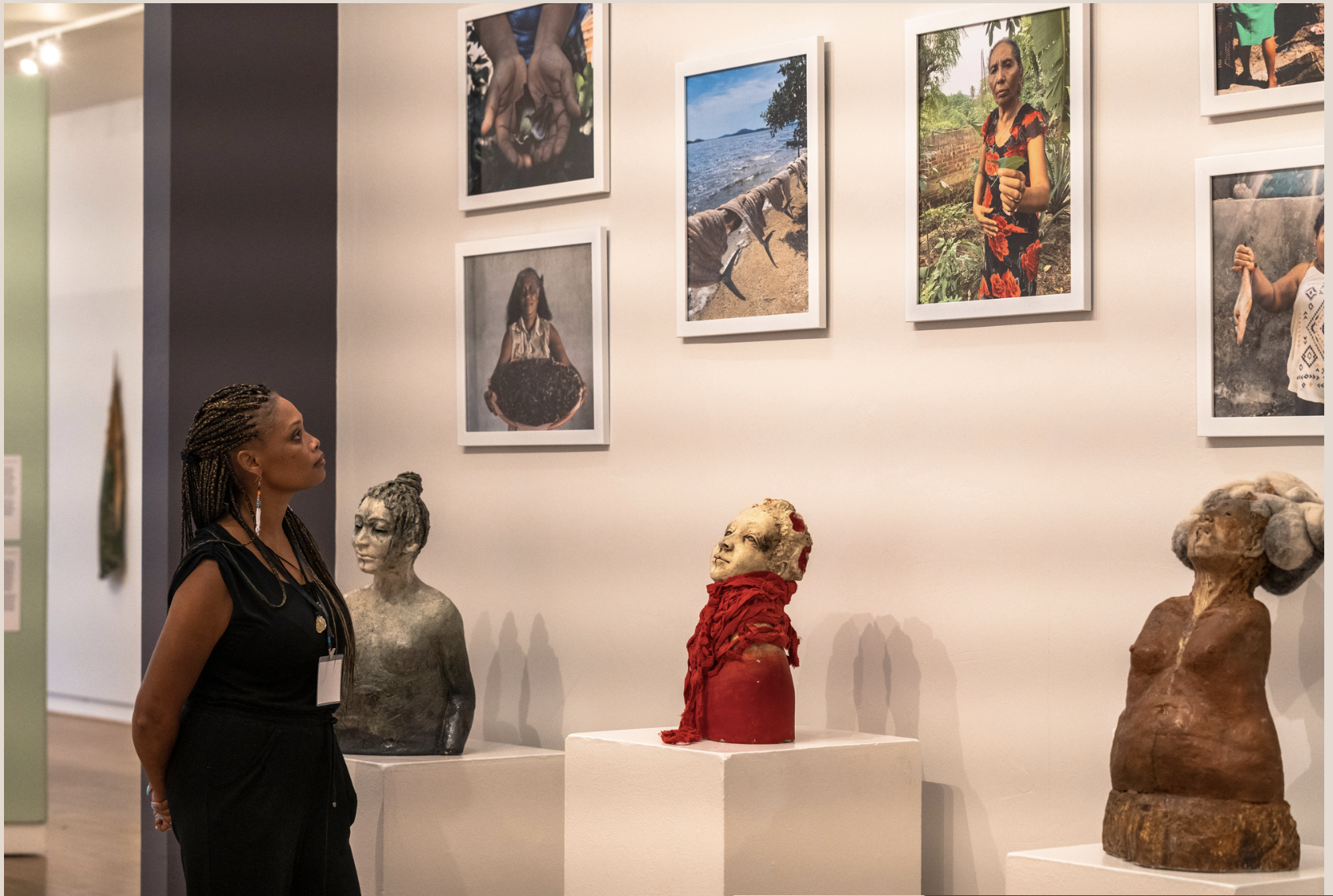
Thank you for this opportunity to share my curatorial journey, projects, and practice with you and the readers of the GFA journal. And thank you for uplifting the words of the great Amílcar Cabral, who was a devoted agronomist and revolutionary. Well, Afro-Ascendance: Stewards of Sustainability, Soil and Sea was born from an innate curiosity about ancestral knowledge which has been used to sustain ecologies across Latin America and the Caribbean. As a woman of Afro- Caribbean roots in both Cuba and Puerto Rico. It feels organic to magnify the voices and contributions of Afro-descendant women who have been earthkeepers, healers, and stewards of their ecosystems. I learned a great deal about the ethos of love and care embodied by each of the eco-feminist cooperatives. This care is not only exemplified in their work, but it’s expressed through every aspect of their being. For example, Brigida, a third-generation Pescadora I interviewed while in the community of Zapatalito, actually prepared a delicious meal for me and the photographer Vivi Cruz Lopez. Lastly, I was also able to draw parallels between their respective cultures and my own, particularly when it comes to honoring sacred land, waters, and people who make it all possible.
GFA: Your project AfroAscendance: Stewards of Sustainability, Soil and Sea looks at the coast of Oaxaca, co-creating with Afro-Mexican ecofeminist cooperatives and local photographers. What did that collaborative, co-creative process teach you about authorship- who gets credited, who gets to shape the story- that a more traditional curatorial role wouldn’t have?
This is an important question that I sat with prior to pursuing this project. The moment I received the curatorial fellowship acceptance from Estudio Abierto, I knew it was essential that this project, Afro-Ascendance, be rooted in a collective vision, one that would center the voices of the very communities who welcomed me and were willing to share their experiences, perspectives, and sacred knowledge. My curatorial praxis is very intentional. This is the reason I chose to work specifically with local photographers. For the first iteration of this project, I was very fortunate to have worked with Fernando Armenghol and Vivi Cruz Lopez, who are native Oaxaquenos… this method allows me to share their stories rather than tell their stories. It is their lived experiences and their narratives. So in this sense, I see myself as a co-author, and I think this is a unique distinction from other types of curatorial practices.
GFA: One entry point into that work is changing how art is displayed to undo colonial habits of looking. Your own description of AfroAscendance frames it as giving visibility to Afro-Latinx women, shifting the paradigm in the face of racialized systems of oppression. One of [the] GFA JOURNAL’s prompts is related: it asks how to unearth a Global South lens on a canonical Western figure. Where do you see your own work inside that larger project of undoing inherited ways of seeing, and what does visibility actually change for the women whose stories you’re documenting?
One of the primary goals I have in mind when curating is to expand the way people see this art, to educate and to help expand one’s worldview. In many ways, AfroAscendance feels like an extension of my own lived experience and lineages. Both Cubans and Puerto Ricans create generative ways to survive and thrive in spite of the threats to their livelihood. We are in the midst of a fuel crisis in Cuba and an ongoing water crisis in Puerto Rico. For example, Cubans built solar-run tricycles to transport trash from each neighborhood, and Puerto Ricans have invented unconventional methods of accessing water while both islands also navigate ongoing blackouts. This is what I see: the revolutionary spirit of my people and the women who had the foresight to establish the cooperatives on the coast of Oaxaca. For multiple generations, they collaboratively preserved their fishing, farming, and healing practices, which subsequently sustained their lands, families, and communities at large. We (Afro-descendants) deserve for our stories to be visible, amplified, and honored, especially given the ongoing attempts of erasure by the empire.
GFA: Maya Angelou described a phrase from Ghana, ‘deep talk,’ language that seems simple on its surface but carries you somewhere deeper the more you sit with it. I see your work as a form of cultural preservation in that same spirit, elevating storytellers whose ‘deep talk’ becomes a framework for artistic expression, and sometimes a way of working through difficult truths. Can you point to a specific exhibition or moment where that ‘deep talk’ shaped your choices, in the artists and collectives you brought together, or in how you translated that deep knowing into the show itself?
I absolutely love this question. Over the arc of my life, I can reflect on many examples where the spirit of “deep talk” helped to ground and frame my approach to this work on profound levels. In 2023, I curated a photographic journal New Works issue of “Nueva Luz” while working as the Curator at Large for Enfoco Inc. Enfoco has a magnificent fifty-year-old archive featuring works of some of the greats, like Sophie Riviera, Jamel Shabazz, Deborah Willis and many others. I was asked to identify five photographers and create a theme from their archive that were part of the New Works program years prior. I naturally gravitated to the works that addressed socio-political issues through powerful stories and images. Such as those of Brazilian photographer Andre Cypriano, whose photographic images were not only aesthetically mesmerizing, but co-created with the Quilombola people. who he had cultivated relationships with for over twenty years. Some who have transitioned to the spirit realm and some who are still with us in the physical. The communities he documented through his lens spoke the language of “deep talk” in every way. As soon as I engaged with his photographs, I knew I wanted to feature his work in the journal and show the world his powerful images.
5. Community care, leading with empathy, shared responsibility, and mutual support rather than hierarchy, seems to be more than just attractive language; it is central to that kind of curation. How does that show up in how you build a show or run your practice day-to-day?
Two aspects of my curatorial practice are guided by the organizing/activist work that I’ve had the blessing of doing for the past twenty-plus years. I live by the principled words of my shero Toni Cade Bambara, who said “Revolution begins with the self, in the self… We’d better take time to fashion revolutionary selves, revolutionary lives, revolutionary relationships. Mouths don’t win the war.” What she called for was an embodied practice, and that’s what makes my curatorial practice meaningful. Whether its photographic images of Afro-ecofeminists addressing environmental justice in Costa Chica. or paying homage toAfro-Puerto Rican, photographer Hiram Maristany, who documented and captured the lives of the Young Lords Party. The organization who fought for dignity, critical services and respect for Puerto Ricans in El Barrio. I am always dreaming up ways to empower my people and our stories with every exhibition I curate. It’s not just my job but my offering to everyone who engages with the work.
6. A third strategy is recovering lost knowledge and untold stories, bringing forward the artists and movements written out of art history: queer, Black, Caribbean, and Global South voices sidelined by a Western-centric frame. Afro-Latinx women often sit at the center of their own work but at the margins of mainstream climate and environmental justice narratives. What do you think these missing pages actually hold, and what do we lose in our ability to approach social, political, and environmental justice when they stay unwritten?
I believe my best curation is intuitive and derives from my commitment to utilize the archive to challenge dominant narratives, and honor the cultures and the people who have been a part of re-imagining a new world for themselves and others. I am deeply interested in how we can learn from the people, places and experiences of the people I highlight in my exhibitions and programs. When I talk about this project and the Afro-Mexican women I shared space and time with, I am often met with a great deal of inquiry. Many people have told me they did not know that there are Afro-descendants in Mexico and/or these communities still use ancestral knowledge. I often share the story of Doña Gloria, a fourth-generation curandera (healer) in Pinotepa, who was healing her community during the pandemic with natural remedies and plant medicine. Neighbors with respiratory issues, diabetes and other ailments came to her home to receive remedies that help to preserve their life. These stories are prevalent throughout Africa, LatinAmerican and the Caribbean, and should never be omitted from our histories, memory or art.
7. Maura Reilly coined the term “curatorial activism” to describe exhibitions built to stop certain artists from being excluded from art history’s master narrative, work by women, artists of color, queer artists, the historically silenced. Where does your own practice sit inside or against that definition? Can you walk me through a specific moment where that commitment changed a curatorial decision, a piece you included, cut, or presented differently because of it?
I appreciate Maura Reilly for coining this term; the Western canon often encourages us to stay safe and situated within old, outdated, and often historically inaccurate narratives. What is refreshing is that as things shift in the art world, many of us feel a responsibility to share truths and counter-narratives to the Western gaze. I am constantly questioning what the piece, whether it’s a photographic image or painting, is trying to communicate to the viewer and how it may land. I am conscious not to include works that cause harm to any marginalized community. I was curating a show a few years ago and decided not to include an image of a young person with a gun because it perpetuated a certain trope and didn’t align with the arc of the thematic framework. As far as I am concerned, integrity should always be a guiding force in one’s curatorial practice and curatorial activism.

8. Curators like Okwui Enwezor reshaped what an exhibition could do politically, treating the show itself as a site of resistance rather than neutral display. Where’s the line, if there is one, between an exhibition and an act of political organizing, and is that a line you want to hold, or blur?
Rest in power to Okwui Enwezor, whose work I deeply admire. He was a visionary who knew the importance of creating spaces for people to be politically educated in his exhibitions. In 2016, I saw a Kerry James Marshall solo exhibition at the Met Breuer. Some of the works depicted empowering and horrific histories experienced by Black people in this country. I overheard an older white woman who was staring at the painting of Fred Hampton who was murdered in his home by the Chicago PD and said who cares about the narrative, I can about the aesthetic. These types of sentiments are why I make a concerted effort to activate one’s consciousness. I aim to open up new sightlines to help expand one’s connection and/or understanding that art and the political sphere are inextricably linked. So I wholeheartedly believe that an exhibition space can offer up an opportunity where new thoughts and ideas can be formulated and where propaganda can be debunked and erroneous narratives can be challenged.
GFA: The Dialectical Third exhibition, and the JOURNAL prompt that grew out of it, explores Warhol’s influence in the Global South by pulling from the marginalized and liminal spaces that occur across art and culture, in language. Warhol’s Ladies and Gentlemen series captures Brown and Black trans and drag women in a kind of liminal existence. Seen but not fully claimed by any one group or culture. That territory, of tension between influence and appropriation, holds for diasporic and subaltern communities. Where do you see that tension play out in your own work, and what does it mean to be an arbiter of culture from that in-between space rather than trying to resolve it?
TI: During my studies at the University of Pennsylvania, I remember reading about ethnographers who were often appropriating and disrespecting the cultures they were researching. My understanding is that I seek to learn when co-creating with the communities I share space and time with. I am not an Afro-Mexican woman; thus, I must honor their rules of engagement and knowledge with the utmost humility and responsibility. I understood that then and now. Although I received a warm welcome into Zapatalito and Pinotepa, I acknowledged that people were still highly affected by COVID. In fact, one of the women I interviewed was fighting to keep her son alive because he had contracted COVID from an ‘extrañjera,’ meaning a foreigner, which understandably caused a great deal of fear. Although I am an Afro-Latina, I also respected the fact that I too was seen as an extrañjera who may not be allowed in certain spaces to conduct interviews, even with a local photographer. I lean into that humility every time I set out to conduct curatorial research, curate a program, or develop an exhibition.
GFA: Coming back to where we started in this conversation, answering to ancestors, children, and the unborn: if radical curation is about rebuilding how we hold knowledge and archives, not just adding to them, what do you hope the unborn inherit, not just in the art itself, but in the ‘deep talk’ passed down, and what do you hope the archive they inherit no longer excludes?
TI: I start with the notion that this work is more than a choice; it is a charge and a responsibility. My ancestors, both living and those who have transitioned, believe in the power of art as a tool for liberation. They were griots in their own right, especially my Abuelo, whose words and music still live today. He was a poet, a successful composer who honored oral histories and preserved our family archive. Now my siblings hold those stories close and share them with our descendants. I often start my guest lectures and presentations with an homage to my ancestors to demonstrate that this work doesn’t start or end with me. Even archives can and should be challenged. I like to question who was authoring some of these histories, whose voice or narrative was being prioritized. Who authored this article? Thus, I hope that those who inherit the knowledge and archive will do a deep dive into why I did this work and for whom I curated this work. We will not be omitted. They will never be able to exclude our stories. It lives in the art, the seeds, the soil, and the sea.
Their attention to detail and commitment to quality truly stood out. We’ve already recommended them to others.
—Former Customer