Contributor
Contributing Essay
Prompt 03
Biography
James l. Tucker
An Unexpected Flash
"The Polaroid: Art, Analog Practice, and Archive"
James L. Tucker (born in NJ) is a printmaker, poet, and writer. He studied at Ringling College of Art and Design before earning a BFA in Printmaking from the Maryland Institute College of Art (MICA) in 2007.
In 2013, he founded The Aesthetic Union, a letterpress shop and design studio in San Francisco, where his own art practice ran alongside the shop's commercial presses.
He sold the studio in 2023 and now lives on the Mendocino coast, where he is building a press and printmaking space in a converted historic water tower: Sun Tower Studios.
His writing, gathered in the Substack Don't Think Twice, moves between craft, community, and the search for an alternative life. He is the author of the poetry collection Hold This Close.
J.L. Tucker (@jameslewistucker) on Instagram
Portfolio: jameslewistucker.com
Substack, Don't Think Twice: jltucker.substack.com
An Unexpected Flash
by James Lewis Tucker
An Unexpected Flash
by James Lewis Tucker
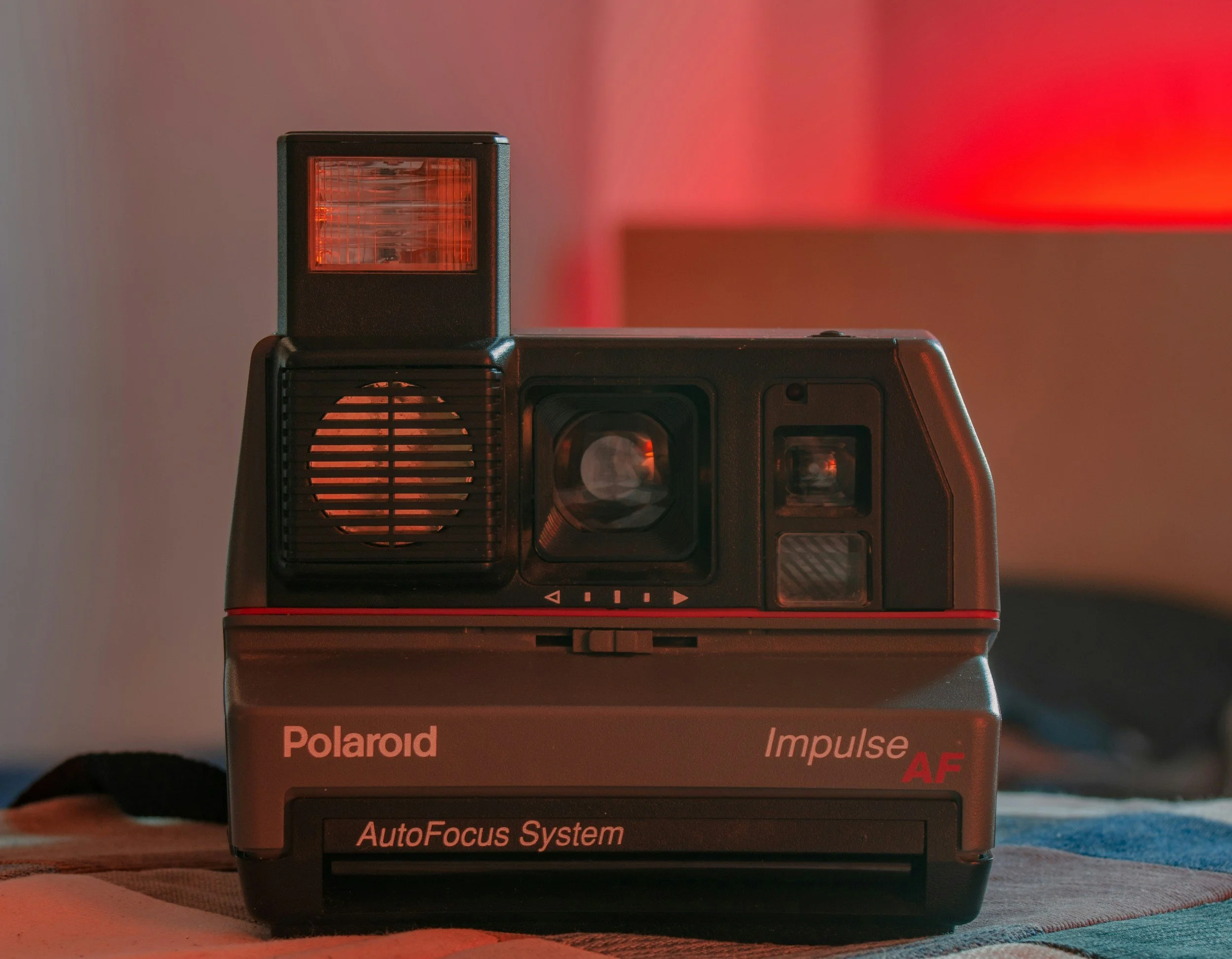
The Polaroids in this essay were left to me by a friend and mentor. What I understand now took a decade of pulling prints in my studio. I worked in silence. The machinery did not. This essay comes out of that hypnotic rhythm, closing the gap between an idea and reality.
After a close friend of mine died, I went through his studio. He was a longtime graphic designer, and he left me a few things. One was a notebook, full of sketches from his college years and his design jobs at WET Magazine and Rolling Stone. The notebook was also filled with Polaroids, taken off the cuff during those years. Small treasures into his mind. His inner workings. Portraits of another time, gifted to me.
I don't know how this actually happens. There's a magic we can all do. Maybe some other animals can do it too, but I'm human, and that's what I know. I don't think it's something a machine can do. I do think machines can help, can assist, like a sewing machine or a printing press. Like a Polaroid camera, or a loom. These tools channel the creative force into an object. An object that appears in the mind's eye first. Where the spark comes from, I don't know. That spark that history called logos.
I don't know what made early humans start painting in caves, but my best guess is it was something similar, the same upwelling in my chest when an idea comes to me. The same feeling of it trying its hardest to get out, somehow, some way. To ignore it is dangerous. To repress it can be deadly.
The best thing I've learned is how to let it flow. Neil Young has talked about what it's like to write a song. Young says when he’s writing he feels like a radio antenna, receiving a signal from who knows where. His guitar and harmonica keep pace with his words. They're the tools he chooses to relay that information to us.
These tools, the closer they are to the human, the less technology between us and the spark, the more in tune we are with the transmission.
Artists repurposing tools to channel the creative force is nothing new. Polaroid, lithography, screen printing, risograph, letterpress. Most of these methods were tools of capitalism's advancement, the reproduction of information to sell things to the masses. In the artist's hands, they can be a tool of transcendence.
When I was primarily a letterpress printer, I used to tell clients: the press is the crucible that takes our ideas and brings them into existence. An alchemical process that whirls with gears and levers. A letterpress machine looks simple, but it isn't. When it first spread through Europe in the 1440s, it was met with real resistance, a technology powerful enough to threaten the people who controlled information. I opened my print studio in San Francisco in 2013, in the first throes of the social media boom. Some thought I was crazy, starting a print shop when everything was going digital. To their surprise, people were hungry for it. They came in just to watch us print. They were fascinated by the process, the smell of the ink, the sound of the machines, a place where people could interact with other people. It was "real" in the middle of a culture pulling toward the "unreal."
Film photography draws a close parallel. It's a complicated process, but a pure one, especially Polaroid photography. It narrows the gap between the spark and the finished piece. A second to
take, minutes to develop. There's no sending it to a lab. You're holding the lab in your hands. It's a brilliant piece of technology because the photographer is so intertwined with the alchemical process of making the piece. The separation between them and the spark is narrow.
Part of the process is the interaction between the artist and the subject. Most Polaroids are taken off the cuff, a surprise moment in a sea of planned events. I think this is what people are hungry for again. Not the planned encounter, but the unexpected flash, an indelible instant portrait of the moment.
Back in my studio, I flip through the notebook my friend gave me. I'm reminded of all the details of his life, some of which he never mentioned. Clues to a much larger story. I wonder what it would be like if he'd never taken these photos, if all he'd left behind was a phone, or an iPhoto album on the Cloud.